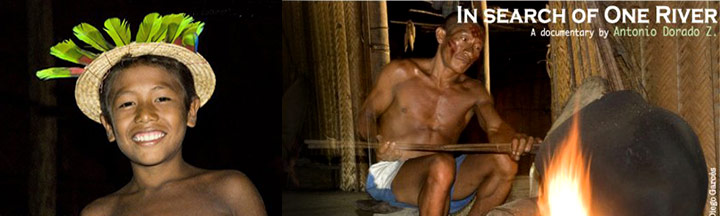
Apaporis | In Search of One River
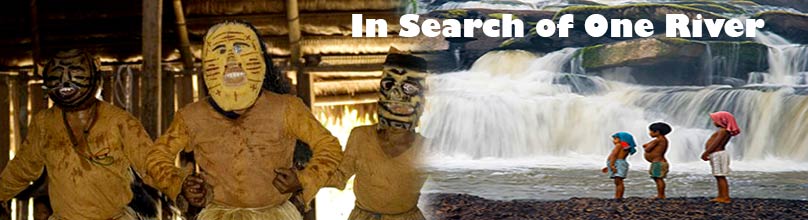
Wade Davis’ book, One River, espoused his knowledge about plants and states of being in the Amazon and the work of his mentor in the Colombian Amazon, Richard Evans Schultes, were the inspiration for the Colombian documentary, Apaporis. Wade Davis is an ethnobotanist, interested in the native uses of plants, especially psychotropics. He found many such plants in the travels he recounts in the book, One River, especially coca and curare.
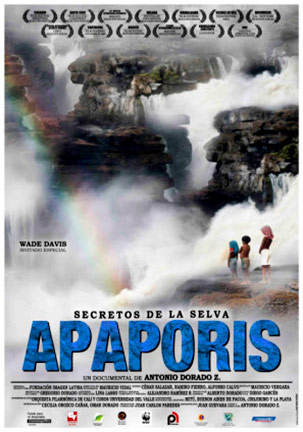 The movie highlights not only the natural beauty of a little-known part of the Amazon rainforest, but also the dependence of the region’s indigenous peoples on the river's resources at many different levels, including culturally and spiritually. This website was created to educate visitors about the significance the river, the people who lived in the surrounding area, as well as about the major players who influenced or were involved in the documentary& Apaporis | In Search of One River.
PLOT SUMMARY: This document takes the viewer on a mystical journey through the untrodden, war-locked Northwest Amazon. It is a window into a forbidden zone of the Amazon, patrolled by violent factions. The secret knowledge of two of the indigenous tribes, the Cabiyari and the Cubeo, their cultures and their insight into nature, life and medicinal and psychotropic plants is slowly revealed throughout the film. I was captivated by the film when I saw it in NYC during its premier in the summer of 2010. I found this website to be very informative and helpful to a better understanding of the documentary and the work of Wade Davis & Richard Shultes.
It appears that some time after the film's release the domain for this website expired and it disappeared from the web. Recently I discovered that the domain was available, so I bought it with the goal of recreating as much of its original content as possible from archived pages. I did not want someone else to purchase the domain and re-purpose the site for something that had nothing in common with the original website. The information from the original site is as relevent today as it was in 2008. Consider the information on this site for its historical value.
I remember when the film was released in NYC. It was July 30, 2010. I or I should say "we" had just finished a complex custom software development project for a NY real estate firm. They had started as a two person company and the expanded quite rapidly. Their COTS programs were not integrated and a lot of time was being wasted. Enter the company I work for and the team that I am part of. Their need for a higher-than-usual expectation of security and privacy practically yelled the need for specialized custom software apps. Many of the security breaches that occur are often the result of hackers taking advantage of known weaknesses in off-the-shelf software. Also their need to scale as the company expanded was a red flag saying you need custom software. The complexity of the job, required gruelling hours on our part. Once it was over we wanted to celebrate. Someone knew someone at the IFC Center where the DocuWeeksTM Theatrical Documentary Showcase was being held, so it was easy to obtain tickets. Apaporis was quite literally, overwhelming with its tidal wave of information and imagery from different places, times and cultural contexts, all clamoring to be processed within 74 minutes. We were all impressed. I still can conjure up memorable and haunting images from the film.
FYI: October 2009
With technical assistance and support from WWF, the Yaigojé-Apaporis National Park was created in this region, at the request of the region’s indigenous peoples who found their ancestral territories threatened by mining concessions. It was by working together, the local indigenous authorities and the Colombian National Parks authority established the 2.2 million acre protected area.They are also collaborating in the management of the park.
2008 Notes & Posts
Wade Davis speaks on the importance of preserving our ethnosphere
March 21, 2008
Wade Davis, current explorer-in-residence of National Geographic and author of the book “One River: Explorations and discoveries in the Amazon rain forest”, gives a presentation about the importance of preserving our global ethnosphere. In this presentation, part of the TED series, Wade highlights examples of cultures and ways of thinking around the world, from the curandero in the Andes to Budhists in Tibet to the Jaguar people who journey beyond the milky way, that are in danger of disappearing today.
+++
March 21, 2008
The documentary “In Search Of One River” is currently in post production. This is an early preview, a short segment about the ecological and cultural importance of the Amazon forest to the world.
Our team traveled the Apaporis river in the Colombian department of Vaupés, one of the most significant corners of the Amazon jungle because of its biological diversity and landscape, and its ethnographic and cultural wealth. The difficulty of fluvial access continues to restrict the interference of settlers in these places and although the communities know about the existence of money, barter continues to be their means of exchange. It is a territory in which 25 languages are spoken and many of them distinguish fifteen tones of green.
Wade Davis’ book One River is inspiration for Colombian documentary on Richard Evans Schultes
+++
March 21, 2008
 Wade Davis’ book One River is inspiration for Colombian documentary on the knowledge about plants and states of being in the Amazon and Richard Evans Schultes work in the Colombian Amazon.
Best known for The Serpent and the Rainbow, Wade Davis is an ethnobotanist interested in the native uses of plants, especially psychotropics. He finds many such plants in the travels he recounts in One River, especially coca and curare. (The first, famously, is a curse in the First World but is a necessity in the Andes, where it promotes the digestion of many kinds of food plants.) Framing Davis’s narrative is an account of the dangerous World War II-era Amazonian expeditions undertaken by his mentor, Harvard biologist Richard Evans Schultes. Davis describes a few hair-raising encounters of his own, making this a fine book of scientific adventure.
From Publishers Weekly
The prodigious biological and cultural riches of the vast Amazon rain forest are being lost at a horrendous rate, according to the author, often without yielding their secrets to the Western world. During his years in the South American jungle, ethnobotanist Davis (The Serpent and the Rainbow) has done much to preserve some of these treasures. He tells two entwined tales here?his own explorations in the ’70s and those of his mentor, the great Harvard ethnobotanist Richard Evans Schultes, beginning in the ’30s. Both men have been particularly interested in the psychoactive and medicinal properties of the plants of the Amazon basin and approach their subject with a reverence for the cultural context in which the plants are used. The contrasting experiences of two explorers, a mere generation apart, starkly demonstrates how much has already been destroyed in the rain forest. Although Schultes probably knew more about Amazonian plants than any Western scientist, he was constantly learning of new ones and new uses for them from native experts. Davis graphically describes the brutal clash of cultures from Columbian times to the present, often so devastating for indigenous peoples, that has defined this region. At times humorous, at times depressing, this is a consistently enlightening and thought-provoking study. Photos not seen by PW.
Copyright 1996 Reed Business Information, Inc. –This text refers to an out of print or unavailable edition of this title.
+++
Production Notes Update — Return from the Apaporis
March 22, 2008
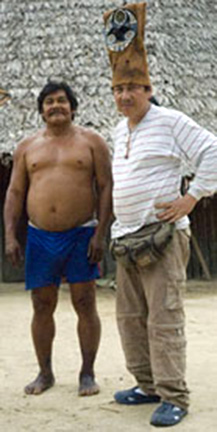 We visited, places, which do not appear on maps. Places like Buenos Aires, a settlement located on the banks of the Canarari river and populated by Cubeos, Baras, Barasanos and Taivanos. On the riverbanks of the Apaporis, we visited the Indian village of Gustavo Pachacuari, captain of the Jirijirimo Union, a settlement which is custodian of the beautiful torrents of the Jirijirimo. This is considered to be one of the most beautiful places in the world. There we attended a Yagé ritual, with dances and music of the Cabiyarí, a legendary tribe recognized for the wisdom of its medicine men and for the anthropophagic customs of their close relatives. After two days in canoe, we visited the Playa where captain Rondón Tanimuca with his family assisted in showing us the Dance of the Doll, the mask dance, which had captivated Schultes so much in his trips through South America. Upon seeing photos of the Schultes expedition, a 90-year-old Tanimucan remembered the professor and recognized two of his deceased brothers. We recorded mythologies, which recognize the particular ways of seeing and thinking of the indigenous people and settlers which populate the Amazon territories today.
There are memories related by payès (medicine men) who, when confronting illnesses, prayers and spells, reveal their conception of the world.Guided by Professor Schultes’ research, we traced and recorded with a high contrast video, unique and events little known to Western vision, such as the preparation of the curare for hunting and the preparation of coca powder for the mambeo*. We also recorded the preparation of dupa, extracted from Virola, one of the strongest secret psychotropics in the world, prohibited for many decades by the missionaries since its effects confuse reasoning more radically than yagé.
+++
Why is Ethnobotany important?
March 21, 2008
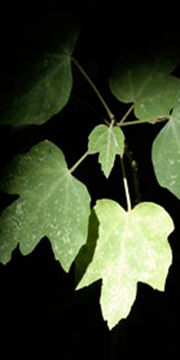 Ethnobotany is very important because it traces the development of humanity, even the most ancient of civilizations relied upon agriculture and the domestication of certain forage, medical, fiber, culinary and plants used for dyes. In our modern world we use less then 100 species for food, yet there are potentially thousands of plants which have yet to be seen in our local markets, and many of these species are more nutritious and flavorful then the ones purchases, yet every other year a new species shows up, a “new exotic fruit”.
Ethnobotany also traces the development of modern Medicine and Herbalism, the Paper Industry, The Chemical Industry, Rubber Industry and as mentioned above the Food Industry.
Every year new species are being discovered or are being reconsidered for modern applications in all the above Industries and Sciences. It has now become a concern of the modern world to preserve and gather all information on the utility of these plant species. And this research is not beyond the reach of the common person, it is just often times over looked, for instance; Do you know the herbal remedies that say your grandmother or great grandmother used to for illnesses? Do you know how they harvested, dyed and made fabric from simple cotton or flax? If not then you can see why this science is most important.
+++
Richard Schultes — The New York Times Obituary
March 21, 2008
 By JONATHAN KANDELL
Published: April 13, 2001, New York Times
Richard Evans Schultes, a swashbuckling scientist and influential Harvard University educator who was widely considered the preeminent authority on hallucinogenic and medicinal plants, died on Tuesday in Boston. He was 86 and lived in Waltham, a Boston suburb.
Dr. Schultes (pronounced SHULL-tees) was often called the father of ethnobotany, the field that studies the relationship between native cultures and their use of plants. Over decades of research, mainly in Colombia’s Amazon region, he documented the use of more than 2,000 medicinal plants among Indians of a dozen tribes, many of whom had never seen a white man before.
”I do not believe in hostile Indians,” Dr. Schultes was quoted as saying in a 1992 article about him in The New Yorker by E. J. Kahn Jr. ”All that is required to bring out their gentlemanliness is reciprocal gentlemanliness.”
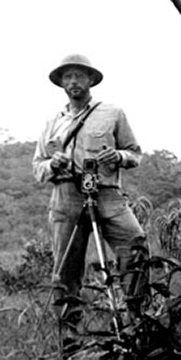
Tall, muscular, wearing a pith helmet, he hiked and paddled through Amazonia for months at a time. He collected more than 24,000 plant specimens. More than 120 species bear his name, as does a 2.2 million-acre tract of protected rain forest in Colombia, Sector Schultes, which the government there set aside in 1986.
”The last of the great plant explorers in the Victorian tradition,” was the way one of his former students, Wade Davis, described him in his 1985 best-selling book, ”The Serpent and the Rainbow” (Simon & Schuster).
But more than a real-life Indiana Jones, Dr. Schultes was a pioneering conservationist who raised alarms in the 1960’s — long before environmentalism became a worldwide concern — that the rain forests and their native cultures were in danger of disappearing under the onslaught of modern industry and agriculture. He reminded his Harvard students that more than 90 tribes had become extinct in Brazil alone over the first three-quarters of the 20th century.
”He believed ours would be the last generation fortunate enough to be able to live and work among these tribes as he had,” wrote one of Dr. Schultes’s disciples, Mark J. Plotkin, in ”Tales of a Shaman’s Apprentice,” (Viking, 1993), ”to experience their traditional way of life firsthand, and to record their vast ethnobotanical knowledge before the plant species — or the people who used them — succumbed to the march of progress.”
Dr. Schultes’s research into plants that produced hallucinogens like peyote and ayahuasca made some of his books cult favorites among youthful drug experimenters in the 1960’s. His findings also influenced cultural icons like Aldous Huxley, William Burroughs and Carlos Castaneda, writers who considered hallucinogens as the gateways to self-discovery.
Dr. Schultes disdained these self-appointed prophets of an inner reality. He scathingly dismissed Timothy Leary, the drug guru of the 1960’s who also taught at Harvard, for being so little versed in hallucinogenic species that he misspelled the Latin names of the plants.
According to a 1996 article in The Los Angeles Times, when Mr. Burroughs once described a psychedelic trip as an earth-shaking metaphysical experience, Dr. Schultes’s response was, ”That’s funny, Bill, all I saw was colors.”
Dr. Schultes may have contributed to the psychedelic era with his ethnobotanical discoveries, but to him these were the sacred plants of Indians that should be studied for their medicinal value. He was in many ways a throwback to an earlier epoch of scientific research. He had no interest in publicity or self-promotion. Rather than confine himself to a narrow specialty, he was a generalist who crisscrossed several scientific disciplines.
Dr. Schultes taught more by personal example than by the use of forceful intellect. His lecture room resembled an ethnographic museum, with huge maps of Amazonia, native dance costumes, demon masks, opium pipes, dried specimens of medicinal and hallucinogenic plants, and a blowgun for poison-tipped darts, whose use he sometimes gingerly demonstrated in class.
His former student, Dr. Plotkin, recalled a lecture in which the professor showed slides of masked dancers in the Amazon under the influence of a hallucinogenic potion. Referring to himself, Dr. Schultes told the class: ”The one on the left has a Harvard degree. Next slide please.”
Richard Evans Schultes traced his fascination with the South American rain forests to the fantasies evoked while he was bedridden as a child. He was born on Jan. 12, 1915, in Boston, where his father was a plumber and his mother was a homemaker. Confined to his room for months with a stomach ailment when he was about 5 years old, he listened enraptured to excerpts read to him by his parents from ”Notes of a Botanist on the Amazon and the Andes,” a travel diary kept by the 19th century British naturalist Richard Spruce. The impression left by those passages was so powerful that the boy decided to follow in Spruce’s footsteps.
Receiving a full scholarship to Harvard, Mr. Schultes wrote an undergraduate paper on the mind-altering properties of peyote, based on research he undertook with Kiowa Indians in Oklahoma who ingested the hallucinogen in ceremonies to commune with their ancestors. For his doctoral thesis, also at Harvard, he chose the plants used by the Indians of Oaxaca, a southern state of Mexico. In his research there, he came across a species of morning glory seeds that contained a natural form of LSD.
In 1941, Dr. Schultes traveled to the Colombian Amazon, where he would spend most of his field research, and an area Spruce had studied. At first, Dr. Schultes concentrated on plants that produced curare. This substance, used by Indians as a fast-dissipating poison to hunt prey, also proved to be vital as a muscle-relaxant during major surgery in hospitals. The professor identified more than 70 plant species from which the Indians extracted curare.
Dr. Schultes was deep in the Colombian rain forest when news of Pearl Harbor reached him more than a week after the Japanese attack. He immediately made his way back to Bogotá, the Colombian capital, and visited the United States Embassy to enlist in the armed forces. But the United States government decided his World War II services would be much more valuable as a botanist doing research on natural rubber, particularly since the Japanese occupied the Malayan plantations that accounted for much of the world’s rubber supplies.
Dr. Schultes soon became the leading expert in the field, collecting and studying more than 3,500 specimens of Hevea, the tree family that produces the latex from which rubber is made.
Throughout the 1940’s and until the early 1950’s, Dr. Schultes lived almost continuously in the South American rain forests, with only brief visits to the United States. On his journeys through the tropics, he traveled lightly. He navigated scores of tributaries of the Amazon River, using an aluminum canoe that he could handle himself, though he usually hired Indians as paddlers and guides.
His supplies included a single change of clothing, a camera and film, a hammock and blanket and a machete and clippers for plant collecting. For food, he carried only cans of instant coffee and Boston baked beans, preferring to rely on food offered by his Indian hosts. This included the ground manioc roots that were their staple, fish, wild game, insect grubs, fruit and chicha, a drink made from fruits chewed and fermented by spittle.
His medicine kit consisted of vitamins, antibiotics and morphine — in case he broke a limb and had to be transported for days before he could receive proper treatment.
To collect and preserve plant specimens, Dr. Schultes devised a method field researchers still use today. He soaked his plants in formaldehyde diluted with water and then pressed them between newspaper sheets. ”On a good day, out in the forest, Schultes would collect 20 or 30 specimens that he thought merited further attention,” Mr. Kahn wrote in The New Yorker. ”Along a riverbank, where foraging was easier, he sometimes bagged 80 or 90.”
Often Dr. Schultes would consult local Indian shamans about the properties of these species. A number of these medicinal plants now carry his name, including, among many others, Pouroma schultesii, a bark whose ashes are used to treat ulcers, Piper schultesii, a stem brewed as a tea to relieve tubercular coughs, and Hiraea schultesii, leaves whose soakings are used to cure conjunctivitis.
Dr. Schultes asserted that contrary to popular conceptions, Indian shamans were eager to share their medical secrets with outsiders. But ”time is running out,” he warned in a 1994 article in the journal The Sciences, asserting, ”The Indians’ botanical knowledge is disappearing even faster than the plants themselves.”
In 1953, Dr. Schultes moved back to the United States as a professor and botanical researcher and curator at Harvard. Six years later, he married Dorothy Crawford McNeil, an opera soprano who performed in Europe and the United States. His wife survives him, as do their three children, Richard Evans Schultes II, a corporate executive; Alexandra Ames Schultes Wilson, a physician; and her twin, Neil Parker Schultes, a molecular geneticist.
Dr. Schultes, who retired from Harvard in 1985, published 10 books and more than 450 scientific articles. For 18 years, beginning in 1962, he edited the scientific journal Economic Botany, and over much of the same period, he served as an active member of the editorial boards of Horticulture, Social Pharmacology, the Journal of Latin American Folklore and other publications.
Among numerous awards, he received the 1992 gold medal of the Linnean Society of London, which is often equated to a Nobel Prize for botany.
+++
Richard Schultes — The Economist Obituary
March 22, 2008
Richard Evans Schultes, jungle botanist, died on April 10th, aged 86
In an account by Richard Schultes of his experiences among the Indians of southern Mexico he described a mushroom, previously unknown outside the region, used to create hallucinations. The account was mainly academic in style; nevertheless it excited a writer who went to the region and sampled the mushroom. His report was published in Life magazine in 1957 under the title “Seeking the Magic Mushrooms”. Thus the “magic mushroom” came to the United States, to be promoted among others by Timothy Leary, one of the high priests of American drug culture of the 1960s, and still remembered for his recipe for supine living, “Turn on, tune in, drop out”.
Although Mr Schultes never expected his botanical discoveries to affect, however indirectly, American social behaviour, he did not criticise Leary and his weird followers for their use of drugs. He merely expressed his disappointment that Leary had not spelt correctly the Latin names of plants from which their drugs were derived.
But Mr Schultes was sad that the public attention given to their hallucinogenic effects distracted from the value of plants as a source of medicines. After his adventure in Mexico he spent many years among tribespeople along the Amazon river. He collected thousands of previously unrecorded plants and reckoned that some 2,000 had medical value. Many more, he believed, were waiting in the jungle to benefit humanity. He liked to talk about curare. For many years it had been known as a powerful, but short term, poison on darts and arrows used by Amazonian natives. Mr Schultes traced the plants that curare came from. They yielded a substance now used as a muscle relaxant in surgery.
He inevitably became concerned that the Amazonian jungle and its inhabitants were disappearing alarmingly quickly. Around 100 tribes have become extinct in Brazil alone in the past few decades. As the tribespeople disappear, so does their knowledge. Mr Schultes saw it as his job “to salvage some of the native medico-botanical lore” before it was lost. Perhaps, he said, the cure for cancer “may come from the witch-doctor’s knowledge of plants”.
His orchid
Richard Schultes’s parents were immigrants from Germany. His father was a plumber in Boston. Young Richard won a scholarship to Harvard, the first member of his family to go to university. In 1941 “as a young botanist, armed with a bright, new doctor’s degree”, as Mr Schultes described himself, he was sent by Harvard on a trip to the Amazon to study medicinal, narcotic and poisonous plants. On his first day in the jungle he found a previously unrecorded orchid. He sent it back to Harvard where it was called Pachyphllum schultesii, the first of many plants attached to his name. He was due to return after a few months but stayed in Amazonia for 14 years. During the second world war he was told to remain in the jungle to look for sources of natural rubber for the United States to replace Asian plantations lost to the Japanese.
Mr Schultes sought to travel simply. His kit is a reproach to overloaded backpackers. He carried a single change of clothing, and little food: he ate the same as his native hosts. He did have a canoe, but it was light enough to carry unaided, and anyway the natives were usually happy to lend a hand. Heavy boots, he found, were usually unnecessary because jungle snakes generally struck at the neck. A pith helmet, though, he found indispensable in the rainforest. This made Mr Schultes resemble an explorer of the Victorian era, which in some ways he was. One of his heroes was Richard Spruce, a 19th-century British naturalist who also explored the Amazon region.
Like the Victorians, Mr Schultes had an unquenchable curiosity that went beyond his speciality. He wrote about the use of hallucinogens in tribespeople’s religious ceremonies. Shamans, medical men, under the influence of hallucinogens believed that they acquired supernatural powers enabling them to cure illness, locate lost articles, affect fertility and control the weather. Mr Schultes saw a connection with stories of European witches who used potions that enabled them to fly. “Flying” was an experience claimed by some of Leary’s followers. Mr Schultes’s Christianity seems to have remained untouched, but he accepted that to Indians throughout the Americas some plants are sacred. One of his books is called “Where the Gods Reign”.
Back from the Amazon with extraordinary tales to tell, Richard Schultes remained at Harvard as a teacher until he retired in his 70s. Students remember his prowess with a blowpipe that he kept in his laboratory. Each year he returned to the Amazon to collect more plants. He received numerous honours. A chunk of Amazonia preserved by the Colombian government is called Sector Schultes. He edited a journal called Economic Botany, covering a science of which he was a pioneer. Mr Schultes remained a modest man. A reporter, awed by his reputation as the world’s top authority on ethnobotany, asked how he should be described. “Just a jungle botanist,” said Richard Schultes.
This obituary appeared in The Economist (London), 2001-05-05, p.88.
+++
Richard Evans Schultes — Daily Telegraph Obituary
March 21, 2008
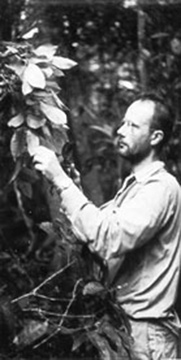 Richard Schultes who has died in Boston, Massachusetts, aged 86, was the father of modern ethnobotany, the study of the use of plants by native cultures such as the Amazonian Indians, among whom he lived in the 1940s.
He was also the leading authority on peyote, ayahuasca and other hallucinogenic plants, and his researches came to influence William Burroughs, Aldous Huxley and the drug culture of the 1960s.
Schultes was regarded as the last of the great plant explorers in the tradition of William Dampier and Alexander von Humboldt. Clad in a pith helmet, for much of the 1940s and 1950s he navigated the tributaries of the Amazon in a portable aluminum canoe, relying on the hospitality of local Indians.
He documented the use by them of more then 2,000 medicinal plants, and gathered some 24,000 specimens. He also gave his name to 120 species, as well as to 2.2 million acres of rain forest protected by the Colombian government; Schultes was among the first to chard the growing threat to the eco-culture of the Amazon.
The hallmark of his work was his sympathy and sensitivity to the ways of life he encountered. He happily chewed coca powder with tribesmen, and treated the often fearsome-looking people he met with disarming courtesy. He never carried a firearm, “I do not believe in hostile Indians,” he said. “All that is required to bring out their gentlemanliness is reciprocal gentlemanliness.”
His research into plants that produces hallucinogens brought his scientific works an underground following in the 1960s, and he met both Burroughs and Timothy Leary. He afforded neither much respect. Schultes chided the latter for mis-spelling the Latin names of plants, and when Burroughs describes a psychedelic trip as an earth-shattering experience, his response was: “that’s funny, Bill, all I saw were colours.”
Richard Evans Schultes was born in Boston on January 12 1915, the son of an engineer who put plumbing in breweries.
As a boy he pressed leaves and flowers, but dated his particular fascination with South America to an illness he had at six which confined him to bed for several months. His parents read to him from Notes of a Botanist on the Amazon and the Andes (1908), the travel diary kept by the English naturalist Richard Spruce, whose adventures made a powerful impression on Schultes.
He was educated at East Boston High School and then won a scholarship to Harvard, where ho soon switched from medicine to botany. Making the peyote cactus the subject of his dissertation, Schultes spent a month with the Kiowa Indians of Oklahoma, who used the sacred cactus ceremonially to commune with their ancestors.
Schultes also partook of the hallucinogen, remarking later that “it would have been unpardonable rudeness to refuse.“
For his doctorate, Schultes then studied teonanactl, the sacred mushroom of the Mexican Indians of Oaxaca, which he was the first to identify, and ololiqui, a vine whose psychoactive seeds have properties similar to LSD.
In 1941, Schultes traveled to the Colombian Amazon to investigate the source of curare, which as well as being poison had also been used in hospitals since the 1930s as a muscle relaxant. He discovered that different types of curare called for as many as 15 ingredients, and in time helped to identify more than 70 species that produced the drug.
During the Second World War, Schultes searched the Amazon for alternative sources of rubber to the Malayan plantations occupied by the Japanese. He taught Indians how to tap latex, and became an expert on the genus Heva, the principle species of rubber tree.
With the return of peace, he once more took to his canoe, and for a dozen years lived in the rain forest.
Sometimes surviving for days on end on tins of condensed milk, he fended off bouts of malaria and beri-beri, once having to paddle for 40 days while ill to reach help. On his travels he collected thousands of samples, many of which were regulaly used by shamans to successfully treat illness.
Some of these plants now carry Schultes’s name, including Pauroma schultesii, a bark whose ashes are used to treat ulcers, and Hiraea schultesii, whose leaves cure conjunctivitis.
Schultes maintained that contrary to popular conception, the Indians were eager to share their medical secrets. But, he warned in 1994: “The Indian people and their knowledge is disappearing even faster than the plants themselves.”
He returned to Harvard in 1953, where he eventually became a professor of biology and director of the university’s botanical museum.
He had a rather quirky sense of humour, sometimes demonstrating his proficiency with a 6ft blowpipe in lectures, and refusing to vote for American presidential candidates, replacing their name on the ballot with that of the Queen.
Schultes published nine books, including Plants of the Gods (1979), written with Albert Hofmann, the chemist who synthesized LSD. He received the Gold Medal of the Linnean Society in 1992.
He is survived by his wife Dorothy (née McNeil), whom he married in 1959, and by two sons and a daughter.